








































What’s the Real Cost of Living in Dubai vs Europe
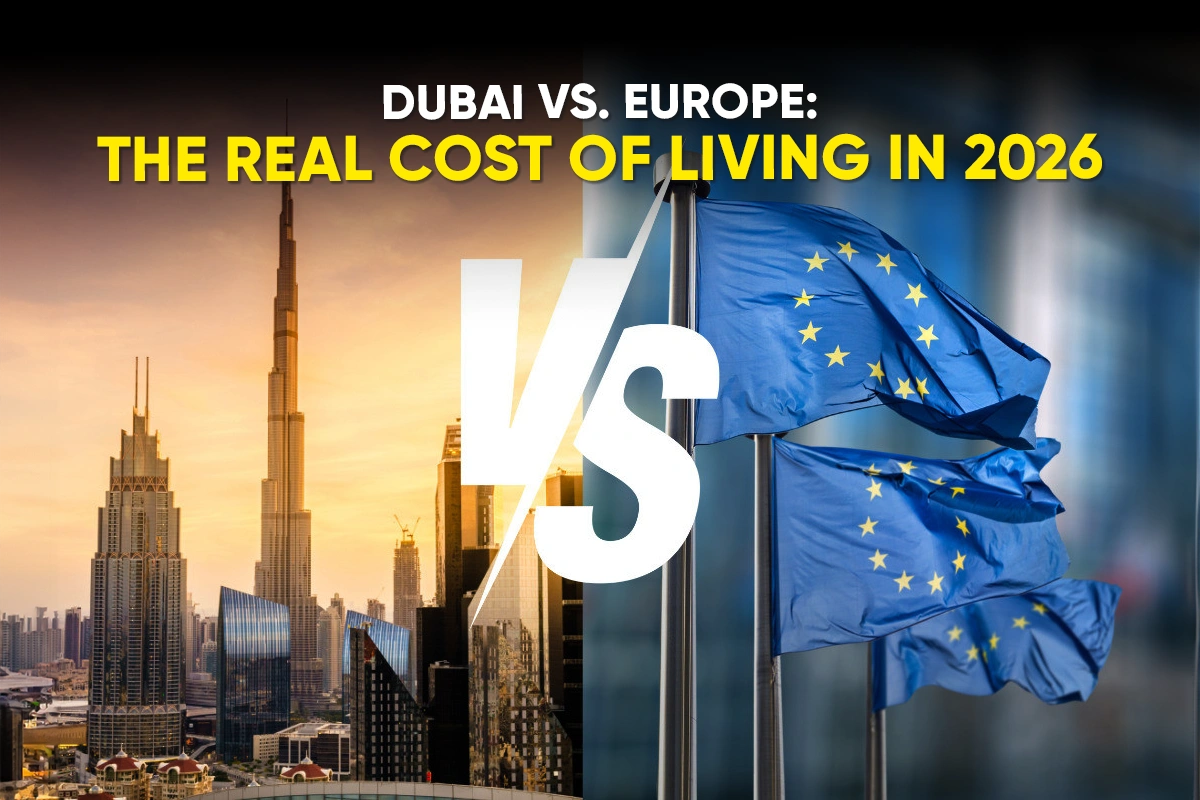
What’s the real cost of living in Dubai vs European cities? Take a look beyond simple currency conversion. Discover the true price of life hidden in plain sight across different regions. Choosing between Dubai and Europe is a major financial decision that will impact your long-term wealth. Comparing these two regions is notoriously difficult because the actual costs are often hidden in different places. You must learn to look beyond the basic price tags to find the actual truth of the matter. In Dubai, you pay for services; in Europe, you pay for the state through a high personal income tax. To give you the most accurate picture, let’s dive beyond simple currency conversions and take a look at the Lifestyle Architecture of each location. You can then decide which location offers you the best value. To ensure this guide provides absolute value, we haven’t just picked the famous capitals. We have selected six European cities that represent the three distinct economic realities you will face on the continent. By comparing Dubai against these tiers, you can see exactly where your specific salary will go furthest. We chose these to represent the high-end ceiling. London is Dubai’s primary rival for talent, while Zurich represents the peak of European costs and high-quality infrastructure. These are the middle ground. They offer the classic European work-life balance. We included them to show how Dubai’s tax-free status stacks up against countries with high social safety nets. These cities are the rising stars of Europe. We included them to show the budget end of the spectrum, where raw living costs are a fraction of Dubai’s, even if the salaries differ. To find the true winner, you must look at ten distinct categories of daily spending. We have analyzed everything from upfront housing deposits to the hidden cost of a weekend coffee. This section breaks down the raw data across our six representative European cities and Dubai. You should pay close attention to the trade-off between low tax and high service costs. Let’s start with the most significant expense for any resident: your home. When you consider the Dubai vs Europe living cost comparison, housing is usually the most significant monthly expense. In Dubai, you often get much more physical space for your money. A standard 1 BHK (one-bedroom) apartment in areas like Dubai Marina typically ranges from 750 to 900 sq. ft. These modern units usually include high-end finishes, floor-to-ceiling windows, and large balconies. However, you must be prepared for the unique way Dubai handles payments. Most landlords still ask for one to four cheques to cover the entire year in advance. This creates a much higher initial barrier compared to the monthly bank transfers common in European cities. The Dubai vs London living cost gap is most visible when you compare floor space. A 1 BHK in Central London is often a period conversion, measuring only 500 to 600 sq. ft. While a modern Dubai 1 BHK costs around AED 8,500, a smaller, older London flat often exceeds AED 11,000. In Berlin, your budget might secure a decent 1 BHK of 650 sq. ft., but the extreme housing shortage makes finding any vacancy difficult. You will find that Eastern European cities like Warsaw offer the best space-to-price ratio. You can rent a luxury 2 BHK (850+ sq. ft.) in Warsaw for nearly half the price of a modest Dubai studio. You must also factor in the Housing Fee in Dubai. This is a 5% tax on your annual rent added to your monthly utility bill. In Europe, you might face Council Tax or municipal fees that vary by neighborhood. These small differences can significantly impact your monthly budget if you do not plan for them carefully. Once you have secured your home, your next major monthly expense will be utilities. In Dubai, this is dominated by air conditioning. You should pay close attention to whether an apartment is Chiller-Free. In these buildings, the landlord covers the cooling of water for your AC, saving you between AED 300 and AED 800 per month during peak summer. However, many modern buildings use District Cooling (e.g., Empower). Here, you will face a separate bill including a Demand Charge—a fixed monthly fee based on your apartment's cooling capacity. Even if you are on vacation with the AC off, you will still pay this base fee. For the expat cost of living Dubai, this adds a predictable floor to your budget that does not exist in most European systems. In Europe, the main utility burden is winter heating via gas or electricity. Recent data shows that electricity in Germany is nearly 30% more expensive per unit than in Dubai. While European bills are often averaged out over 12 months, Dubai’s bills fluctuate wildly. You should budget for seasonal swings, as a bill might jump from AED 400 in January to AED 1,200 in July. In Dubai, owning or renting a car is often seen as a necessity rather than a luxury. You will find that petrol prices in the UAE (approx. AED 2.40/L in early 2026) are nearly three times cheaper than in London or Berlin. Furthermore, purchasing a vehicle is more affordable here due to 0% sales tax and low 5% import duties. Financing is also accessible, with interest rates often as low as 2-3%. However, the hidden costs of driving in Dubai add up quickly. You must factor in Salik (toll) fees, which cost AED 4-6 per crossing, and mandatory annual registration. In contrast, European cities like Berlin or Zurich offer world-class public transport. You can often live entirely car-free, saving thousands on insurance and maintenance. The Dubai vs London living cost for commuters often hinges on this: London’s Travelcard is expensive, but it removes the need for a AED 30,000+ car investment. If you choose to use the Dubai Metro, your costs stay very low (AED 350 for a monthly pass). But the last mile is the challenge. Unlike walkable European capitals, Dubai’s heat often forces you into a taxi or Uber for short trips. This convenience tax can quietly inflate your expat cost of living in Dubai if you do not live directly on a Metro line. In Dubai, health insurance is mandatory for all residents. While employers must provide basic coverage for staff, you are often responsible for your family’s premiums. A standard mid-range plan for an individual costs between AED 5,000 and AED 8,000 annually. You should also expect a co-payment (usually 20%) for most consultations and medications. European systems, like those in Germany or the UK, are funded through high social security taxes. This means you will rarely see a bill at a hospital. However, these taxes can consume nearly 7% to 15% of your gross salary. While Dubai has shorter wait times for specialists, Europe offers a safety net that protects you even if you lose your job. You must consider the hidden speed of the Dubai system. You can often see a specialist on the same day without a referral. In many European cities, you must see a General Practitioner first, which can delay treatment by weeks. For many, this time value makes the Dubai insurance premiums feel like a worthwhile investment in their health. Your grocery bill in Dubai depends heavily on your origin. If you stick to local produce and regional brands from supermarkets like Viva or Lulu, your costs will be lower than in London or Zurich. However, if you insist on imported European cheeses, meats, and specialty organic goods, expect to pay a 30% to 50% import premium. Dining out in Dubai is a major part of the social culture and offers extreme variety. You can enjoy a filling old Dubai cafeteria meal for just AED 15 or a world-class business lunch for AED 130. In Europe, mid-range dining is often more expensive due to higher labor costs and VAT. However, the supermarket culture in Europe is more affordable for high-quality fresh produce across the board. You should also factor in the service economy. In Dubai, food delivery is exceptionally cheap and available 24/7. In Europe, high delivery fees and driver tips make ordering in a luxury rather than a daily habit. This convenience can quietly inflate your cost of living Dubai if you rely too heavily on apps like Talabat or Deliveroo. Families often find that the absence of income tax in the UAE is balanced out by the high cost of international schools. You can expect to pay anywhere from AED 35,000 to AED 100,000 per child, per year. These premium schools offer world-class facilities like Olympic-sized pools and specialized STEAM labs. However, these fees do not include extras like mandatory uniforms, school transport, or extracurricular activities. Contrast this with the pre-paid systems found in Germany or Poland. If you live in Berlin, your children can attend local public schools for free, receiving an education that is globally respected. Even in the private sector, European International Schools are often more affordable than Dubai's top-tier institutions. When you weigh the Dubai vs Germany debate, the free education in Europe often offsets the higher tax burden for families with multiple children. You should also look at the long-term university horizon. In Dubai, higher education remains expensive for expats, with few local subsidies available. Meanwhile, many European countries offer free or heavily subsidized university tuition even for international students. This long-term saving can represent hundreds of thousands of dirhams in your family's pocket over a decade. Living in Dubai allows you to buy back your time at a fraction of the cost found in Europe. For instance, a professional home cleaning service in Dubai typically costs between AED 30 and AED 40 per hour. In contrast, hiring a cleaner in London or Berlin will often set you back AED 90 to AED 120 per hour. This massive price difference makes daily or weekly help accessible to most mid-level professionals in the UAE. The cost of living in Dubai is also uniquely shaped by the availability of full-time domestic help. Many families choose to sponsor a live-in nanny for a monthly salary ranging from AED 2,500 to AED 4,500. In cities like Zurich or Paris, a similar full-time arrangement is financially impossible for most, often costing upwards of AED 15,000 per month. This convenience culture extends to laundry and car washes, which are frequently delivered right to your door. Remember that while these services are cheap, they represent a recurring monthly subscription to your lifestyle. In Europe, you might save money by doing these tasks yourself, but you lose significant personal time. When you evaluate Dubai vs Germany which is better, you must decide if you value your weekend hours more than the dirhams spent on help. Dubai is a city designed for consumption, offering a pay-to-play lifestyle that can be as cheap or as expensive as you allow. While public beaches are free, most social life revolves around private beach clubs, high-end malls, and ticketed attractions. In contrast, European cities often provide a wealth of free culture, such as public parks, historic walking tours, and state-subsidized museums. The Dubai vs Germany debate often centers on how you spend your weekends. In Berlin, a modest AED 150 can cover a full day of museum hopping and park-side dining. In Dubai, that same amount might only cover a single cinema ticket with popcorn and a drink. However, Dubai offers world-class luxury experiences, like temperature-controlled outdoor pools in January, which are simply unavailable in the European winter. You must be disciplined with your social tax in the UAE. The temptation to keep up with the Joneses through brunching and luxury shopping is high. In Europe, social status is often less tied to visible spending, which can make it easier to maintain a modest leisure budget. When calculating your of living cost in Dubai, always add a 20% buffer for these inevitable social invitations. Connecting your home in Dubai is often more expensive than in any major European hub. A standard 500 Mbps fiber connection typically starts around AED 380 per month, often bundled with a landline and basic TV you may never use. In contrast, you can secure similar or faster speeds in cities like Bucharest or Warsaw for less than AED 100. This digital tax is a fixed cost that you must factor into your monthly cost of living Dubai. Mobile data follows a similar trend, as the UAE currently has some of the highest prices per gigabyte globally. While you might pay AED 200 for a modest data plan in Dubai, a similar unlimited plan in London or Berlin often costs less than half that amount. Furthermore, European residents benefit from Roam Like at Home regulations, allowing them to use their data across 27 countries at no extra charge. You should also be aware of Voice over IP (VoIP) restrictions in the UAE. While apps like WhatsApp and FaceTime work for messaging, video and voice calls are often restricted unless you use government-approved platforms like Botim. In Europe, these services are entirely free and unrestricted. If you rely on international video calls to stay in touch with family, these small technical differences can impact your overall digital experience and budget. The final piece of the financial puzzle is your net take-home pay. While we have compared many costs, the most dramatic difference lies in how much of your salary actually reaches your bank account. In Europe, your gross salary is a theoretical number. By the time income tax and social security are deducted, you may lose 35% to 50% of your earnings. In Dubai, your gross salary is your net salary. You keep 100% of your paycheck, which allows for much higher aggressive saving or investment. However, you must be disciplined. European taxes fund a state pension and unemployment safety net that does not exist for expats in the UAE. You are responsible for building your own private pension using the extra cash you retain each month. The wealth gap becomes clear after five years of living in either region. Even with higher service costs in Dubai, the ability to save nearly 40% more of your base income is a powerful wealth builder. You must decide if you prefer the security of the European social net or the high-growth potential of a tax-free environment. After analyzing these ten dimensions, the question remains: does the tax-free salary in Dubai actually outweigh the higher costs of private services? We have crunched the cumulative data to give you a definitive answer based on your specific life situation. Dubai is generally cheaper than Europe’s premier Tier 1 capitals (like London, Zurich, or Geneva), but it is more expensive than most of Continental Europe. If you are a single professional or a young couple, Dubai is the undisputed winner for wealth accumulation. The combination of 100% take-home pay and significantly lower transportation and service costs allows you to save at a rate that is mathematically impossible in Europe. In cities like London or Berlin, the tax bite and high energy costs create a ceiling on your monthly savings that even a high salary cannot easily break. However, the equation shifts for families with multiple children. The European Model offers a massive hidden subsidy through free, high-quality education and universal healthcare. In Dubai, school fees for two children can easily reach AED 120,000 per year. For a family to enjoy the same net financial gain in Dubai as they would in Europe, the Dubai salary usually needs to be at least 40% higher than the European gross offer. The Dirham’s peg to the US Dollar ($1 = AED 3.67) provides a shield against the currency volatility common in Europe. If you hold debts or investments in Dollars, your Dubai salary maintains a fixed value. In Europe, a 5% drop in the Euro or Pound can instantly devalue your international savings. Repatriating from Dubai requires a settlement budget of AED 15,000 – 20,000. Unlike the low-cost exits in Europe, you must settle visa cancellation fees, utility disconnection charges, and early lease termination penalties—which typically cost two months' rent. Failure to clear these debts can result in travel bans. Dubai uses a user-pays model. You will pay AED 20 Knowledge and Innovation fees on most government transactions, 5% VAT on goods, and a 5% Housing Fee on your annual rent. In Europe, these municipal and administrative costs are generally covered by your high personal income tax. In Europe, your pension is pre-funded through mandatory tax deductions. In Dubai, you receive a lump-sum End of Service Gratuity, but this is rarely sufficient for retirement. To match a European safety net, you must manually reinvest at least 15% of your tax-free salary into private funds. Yes. While petrol is cheaper, the extreme heat requires a car service every 10,000km or six months. Tires, AC filters, and cooling systems degrade twice as fast as in Europe. Budget AED 2,500 – 4,000 annually for maintenance to avoid the costly repairs caused by sand and heat.The Comparison Map: Why These Cities?
● London & Zurich: The Global Heavyweights
● Berlin & Madrid: The Lifestyle Hubs
● Warsaw & Bucharest: The Value Capitals
The 10 Dimensions of Cost Comparison
#1. Dubai vs Europe: Housing Comparison
#2. The Utility Trade-off: AC vs Heating
#3. Commute Costs in Dubai vs. Europe
#4. Dubai vs. Europe: Healthcare & Insurance
#5. Food and Dining Expenses
#6. Education and Schooling in Dubai vs. Europe
#7. Dubai vs Europe: Chore Outsourcing Costs
#8. Entertainment and Leisure: Dubai vs. Europe
#9: Communication and Digital Costs in Dubai vs Europe
#10. Dubai’s Tax and Savings Equation
The Final Verdict
FAQs
1. Does the USD-Dirham peg offer a financial advantage over the Euro?
2. What is the actual cost of exiting Dubai?
3. Are there hidden government fees instead of income tax?
4. How does the cost of retirement planning differ?
5. Is vehicle maintenance more expensive due to the climate?
Leave a Reply
Your email address will not be published. Required fields are marked *
Car Rental in Dubai


AED 2500
DAY
AED 55000
MONTH
-
 SUV
SUV - 4 Doors
- 5 Seats
 SUV
SUV  4 Doors
  5 Seats
 - 1 Day Rental Available
- Deposit: Not Required
- Insurance Included

AED 5500
DAY
MONTH
- Sports
- 2 Doors
- 2 Seats
- 1 Day Rental Available
- Deposit: Not Required
- Insurance Included

AED 1200
DAY
MONTH
- SUV
- 4 Doors
- 5 Seats
- 1 Day Rental Available
- Deposit: Not Required
- Insurance Included

AED 1600
DAY
MONTH
- SUV
- 4 Doors
- 5 Seats
- 1 Day Rental Available
- Deposit: Not Required
- Insurance Included

AED 1500
DAY
MONTH
- SUV
- 4 Doors
- 5 Seats
- 1 Day Rental Available
- Deposit: Not Required
- Insurance Included